
WHAT IS GANODERMA ?
Ganoderma lucidum, a medicinal mushroom whose name in Latin means “Red shiny skin,” has been used in Traditional Chinese Medicine for thousands of years. It is also known as “Lingzhi” in China, “Reishi” in Japan, and “Youngzhi” in Korea. The mushroom's history is documented in the ancient Chinese pharmacopeia, "Sheng Nong’s Herbal Classic," where it was revered as a symbol of prosperity, peace for the nation, and longevity for the emperor.
Modern medical references, including the Pharmacopoeia of the People's Republic of China and the American Herbal Pharmacopoeia and Therapeutic Compendium, have also recognized its health benefits.
Ganoderma lucidum is a type of fungus that naturally grows on fallen logs and broadleaf trees and consists of two main parts: the mycelium and the fruiting body.
The mycelium is the white, root-like vegetative network that absorbs nutrients for growth.
The fruiting body is the visible, umbrella-shaped part of the mushroom.
Simply put, the mycelium acts like the “roots” or foundation, while the fruiting body is the “mushroom cap” that people see and use.
Research has shown that the fruiting bodies of Ganoderma lucidum contain a greater variety of active components, and more complex Reishi polysaccharides, and higher content of triterpenoids, providing a richer range of health-promoting bioactive compounds. In contrast, the mycelium contains higher levels of protein and peptides, which support its growth when comparing these two stages.
Therefore, by combining both the mycelium and fruiting bodies of Ganoderma lucidum, we can harness the full spectrum of its health benefits.
Life cycle of Ganoderma
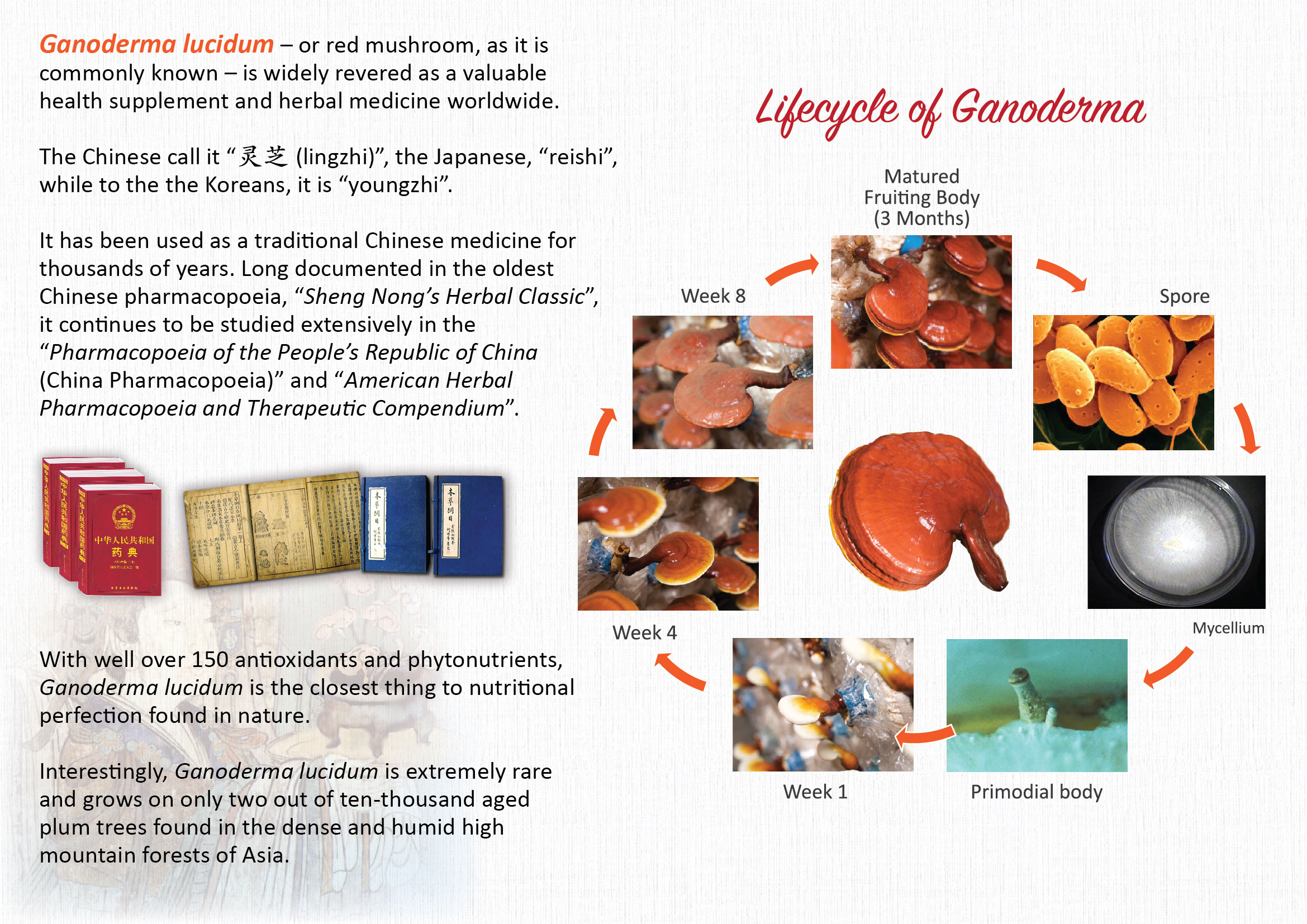
Mature fruiting body (3 months)
Spore
Mycelium
Primordial body
Week 1
Week 4
2 months